
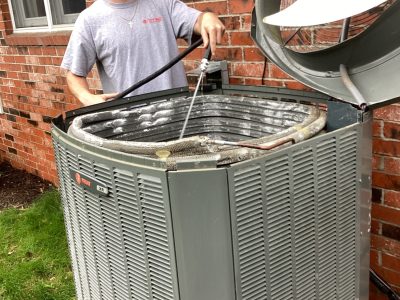
The most common signs of a failing AC compressor include warm air coming from the vents, unusually long cooling cycles, loud clicking or grinding noises, frequent circuit breaker trips, vibrating outdoor units, rising electricity bills, and an air conditioner that struggles to reach the thermostat setting.
While these symptoms don’t always mean the compressor has failed, they should never be ignored. Continuing to operate a system with compressor problems can cause additional damage and significantly increase repair costs.
What Does an AC Compressor Actually Do?
Many homeowners think the outdoor unit beside their home is simply a large fan.
In reality, the compressor hidden inside that cabinet is the heart of the entire air conditioning system.
Its job is to compress refrigerant gas into a high-pressure, high-temperature state before sending it through the condenser coil. Without this pressure change, the refrigerant cannot absorb heat inside your home or release it outdoors.
Every cooling cycle depends on the compressor.
When it begins to fail, the entire refrigeration process becomes less efficient until cooling performance drops dramatically or stops altogether.
This is why HVAC technicians often describe the compressor as the “engine” of an air conditioner.
Why Compressor Problems Should Never Be Ignored
Unlike clogged filters or dirty condenser coils, compressor problems tend to become progressively worse.
As internal components wear, the compressor has to work harder to produce the same amount of cooling. This extra strain increases electrical consumption, raises operating temperatures, and places additional stress on other HVAC components.
In many cases, a compressor doesn’t fail because it was defective.
It fails because another issue—such as low refrigerant, dirty coils, restricted airflow, or electrical problems—forced it to operate under extreme conditions for months or even years.
That’s why identifying the warning signs early is so important.
Your AC Is Blowing Warm Air
One of the earliest and most obvious symptoms of compressor trouble is warm or room-temperature air coming from the supply vents.
Since the compressor circulates refrigerant throughout the cooling system, a weak or failing compressor cannot maintain the pressure required for effective heat transfer.
As a result, your air conditioner continues running, but the air coming from the vents feels only slightly cool—or not cool at all.
Warm airflow doesn’t always mean the compressor has failed. Low refrigerant, frozen evaporator coils, thermostat issues, or dirty coils can produce similar symptoms. However, compressor failure should always be considered when cooling performance suddenly declines.
Your Air Conditioner Runs Constantly
If your AC seems to run all afternoon without ever reaching the temperature you’ve selected, the compressor may no longer be producing sufficient cooling capacity.
As compressors age, internal valves, bearings, and pistons begin wearing down. This reduces compression efficiency, meaning the refrigerant cannot circulate properly.
The result is an air conditioner that runs longer while delivering less cooling.
Many homeowners mistakenly believe the thermostat is defective when the real issue lies inside the compressor.
Strange Noises From the Outdoor Unit
Healthy compressors are relatively quiet.
If you suddenly hear unusual sounds coming from the outdoor condenser, the compressor could be developing internal mechanical problems.
Grinding noises often indicate worn bearings.
Rattling may suggest loose internal components.
Buzzing can point toward electrical issues.
Loud clicking during startup may indicate a failing compressor relay or internal damage.
Metal-on-metal sounds should never be ignored, as they often indicate significant internal wear.
Your Circuit Breaker Keeps Tripping
Compressors draw the highest electrical current of any component inside an air conditioning system.
When internal mechanical resistance increases, the compressor requires even more electricity to start and operate.
Eventually, this excessive current may trip your home’s circuit breaker.
If resetting the breaker repeatedly becomes necessary, stop using the system until it has been inspected.
Repeated breaker trips aren’t just inconvenient—they’re an important electrical safety warning.
Cooling Performance Gradually Declines
Unlike sudden component failures, compressor wear usually happens gradually.
Many homeowners don’t notice the decline because it occurs over several months.
At first, the house takes slightly longer to cool.
Then the indoor temperature starts creeping higher during hot afternoons.
Eventually, the system can no longer maintain comfortable temperatures.
This slow loss of cooling capacity is one of the classic signs of compressor deterioration.
Your Energy Bills Keep Increasing
One symptom many homeowners overlook appears on their monthly utility statement.
As compressors lose efficiency, they consume more electricity while producing less cooling.
The system operates longer, draws more power, and struggles to satisfy the thermostat.
If your cooling habits haven’t changed but your electric bill continues rising each summer, compressor efficiency should be evaluated during a professional HVAC inspection.
The Compressor Shuts Off After Only a Few Minutes
Some failing compressors overheat quickly.
Once internal temperatures become excessive, built-in safety controls automatically shut the compressor down to prevent catastrophic damage.
After cooling slightly, the compressor attempts to restart.
This repeated cycle of running briefly, shutting down, cooling off, and restarting is known as thermal overload cycling. It almost always requires professional diagnosis.
Ice Forms on the Refrigerant Lines
Many homeowners assume ice means the air conditioner is cooling exceptionally well.
The opposite is often true.
A struggling compressor can contribute to abnormal refrigerant pressures that allow ice to develop on refrigerant lines or the evaporator coil.
Frozen coils reduce airflow even further, creating a cycle that dramatically reduces cooling performance.
While ice can also result from airflow restrictions or refrigerant leaks, compressor problems should always be considered during diagnosis.
Your HVAC Technician Measures Low Compression
Some compressor problems simply cannot be diagnosed by appearance alone.
Professional HVAC technicians use pressure gauges, amp meters, temperature measurements, and specialized testing equipment to determine whether the compressor is producing adequate refrigerant pressure.
Low compression readings often confirm internal wear long before complete failure occurs.
This type of diagnosis requires specialized equipment and training.
What Causes an AC Compressor to Fail?
After repairing thousands of air conditioning systems, I’ve found that compressors usually don’t fail randomly.
Most failures are the result of ongoing stress placed on the system over time.
Low refrigerant caused by leaks is one of the leading causes. Refrigerant cools the compressor as it circulates, so low levels can cause excessive operating temperatures and premature wear.
Dirty condenser coils are another common culprit. When outdoor coils become coated with dirt, leaves, grass clippings, or cottonwood, the compressor has difficulty releasing heat, forcing it to work much harder.
Restricted airflow caused by clogged air filters or dirty evaporator coils also increases compressor workload.
Electrical issues—including failing capacitors, loose wiring, voltage fluctuations, and contactor problems—can damage compressor motors over time.
Improper installation is another overlooked cause. Systems that contain incorrect refrigerant charges, contaminated refrigerant, or improperly sized components often experience shortened compressor life.
Finally, simple age plays a role. Most residential compressors last between 12 and 20 years when properly maintained, although regular servicing can significantly extend their lifespan.
Should You Repair or Replace the Entire AC?
If your air conditioner is only a few years old and the compressor is still covered under the manufacturer’s warranty, compressor replacement often makes financial sense.
However, if the system is 12 to 15 years old, uses obsolete refrigerant, or has required multiple major repairs, replacing the entire system is often the better long-term investment.
A new high-efficiency air conditioner can significantly reduce energy costs while improving comfort, reliability, and indoor humidity control.
Final Thoughts
A failing AC compressor is not a problem that fixes itself. In nearly every case, the warning signs begin subtly before progressing into a complete loss of cooling. Warm air from the vents, longer cooling cycles, unusual noises, frequent breaker trips, rising utility bills, and an outdoor unit that struggles to start are all indications that something may be wrong with the heart of your air conditioning system.
The key is not to panic at the first symptom but to avoid ignoring it. Many issues that place excessive strain on a compressor—such as dirty coils, clogged filters, refrigerant leaks, or failing electrical components—can be corrected before permanent damage occurs. The sooner these problems are identified, the better your chances of avoiding a costly compressor replacement.
If your air conditioner has been showing any of these signs, scheduling a professional inspection is the smartest next step. An experienced HVAC technician can accurately diagnose the cause, recommend the most cost-effective solution, and help ensure your system continues to keep your home comfortable for years to come.
By understanding how the compressor works and recognizing the early symptoms of failure, you’ll be in a much better position to protect one of the most important—and expensive—components of your home’s cooling system.

 Is It Fine to Leave Your AC On 24/7?